
Allergens on the menu: the 14 EU allergens for restaurants
A guest with a nut or gluten allergy cannot "taste what is in the dish". That is why allergens on the menu are among the most important things a venue must know and be able to show. The rules come from an EU regulation, and the 14 allergens are a precisely defined list.
Allergens
- 1Gluten
- 2Milk
- 3Eggs
- 4Nuts
- 5Sesame
- 6Fish
In short
- Regulation (EU) No 1169/2011 defines 14 allergen groups (Annex II). Allergen information is mandatory for non-prepacked food too, such as dishes served in a restaurant.
- Member states decide how this information is provided for non-prepacked food. For Bulgaria, check the current ordinance and ask БАБХ (the Bulgarian Food Safety Agency).
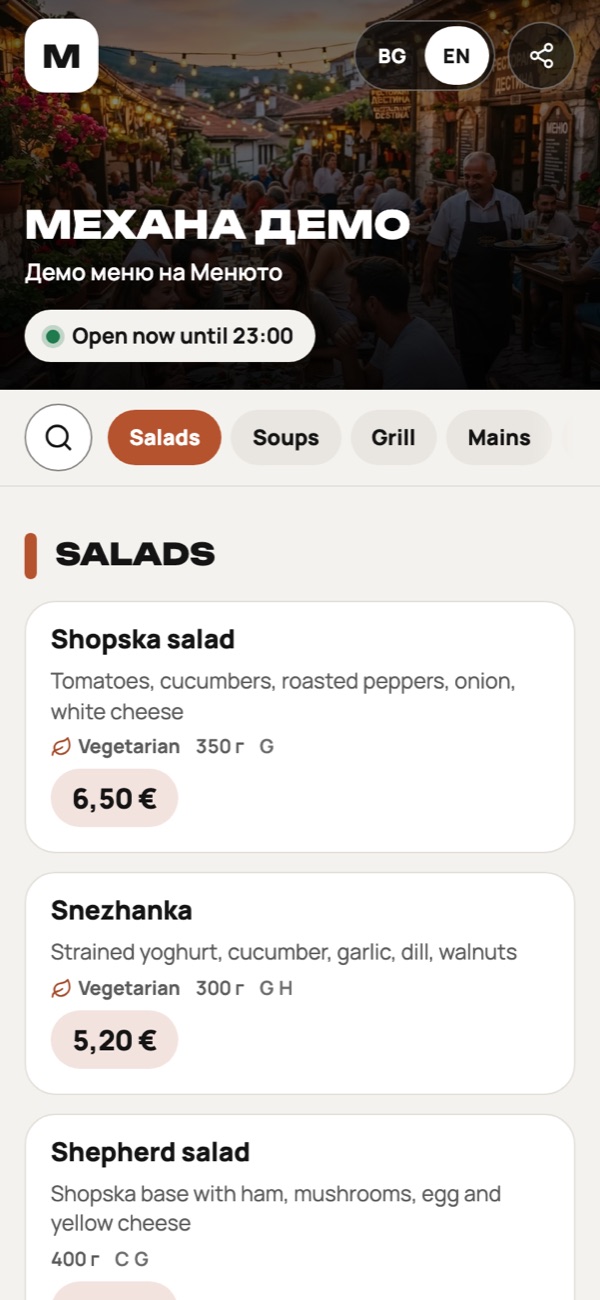
- The most practical way: a number or icon on each dish and a legend in the menu.
- A digital menu keeps the information current and allows filtering by allergen.
- Information is only as good as the kitchen process and the conversation with the waiter.
What the law says about allergens on the menu
The basis is Regulation (EU) No 1169/2011 on food information to consumers. It requires that ingredients and substances causing allergies or intolerances, listed in Annex II, are indicated. This applies to non-prepacked food as well, such as dishes in a restaurant (Article 9(1)(c) and Article 44).
For non-prepacked food the regulation leaves it to member states to decide in what form the information is given: written, oral or combined (Article 44(2)). So it is not enough to know the European rule, you must also check the national ones.
In practice this means two things. First, you must be able to say what each dish contains. Second, the guest needs an easy way to get that information without having to plead with the staff. A menu with marked allergens and a prepared team covers both.
Allergy, intolerance and diet are different things
The list of 14 groups covers the most common triggers of allergies and intolerances. It says nothing about vegetarian, vegan or halal menus. If you label those too, do it separately and honestly so you do not blur what the guest understands.
The 14 mandatory allergens and where they hide
The Annex II list is the same in every EU country. The examples below are for kitchen practice and are not exhaustive: always check the labels of the products you use.
Cereals containing gluten1
Wheat (also spelt, khorasan), rye, barley, oats. Hides in breading, roux, sauces, beer, some sausages.
Crustaceans2
Shrimp, crab, lobster. Hides in fish soups, pastes, seafood sauces, shrimp paste.
Eggs3
Beyond omelettes: mayonnaise, pasta, breading, pastries, some sauces.
Fish4
Hides in Worcestershire sauce, Caesar dressing (anchovy), fish stock, some pastes.
Peanuts5
Peanut butter, Asian and satay sauces, some pastries and muesli.
Soybeans6
Soy sauce, tofu, miso, some breads and prepared meats.
Milk (incl. lactose)7
Cheese, butter, cream, yogurt, but also mash, sauces and milk bread.
Tree nuts8
Almonds, hazelnuts, walnuts, cashews, pecans, Brazil nuts, pistachios, macadamia. Hides in pesto, desserts, salads, breading.
Celery9
Root, stalk and leaves. Hides in stocks, spice mixes, sauces and salads.
Mustard10
Seeds, powder, paste. Hides in dressings, mayonnaise, marinated meats.
Sesame11
Seeds and tahini. Hides in bread, buns, hummus, Asian sauces.
Sulphur dioxide and sulphites12
Above 10 mg/kg or 10 mg/l as SO₂. Wine, dried fruit, some canned goods and pickles.
Lupin13
Lupin seeds and flour. Hides in some breads, pasta and gluten-free products.
Molluscs14
Mussels, oysters, squid, octopus, snails. Hides in fish soups and oyster sauce.
For most groups Annex II adds "and products thereof" and lists a small number of exceptions (for example fully refined soybean oil). The exceptions are narrow and technical: if you are unsure, treat the product as containing the allergen.
A line such as "may contain traces of…" does not replace the process. It is extra honesty toward the guest, not a reason to skip controlling cross-contact in the kitchen.
How to mark allergens on the menu
The EU regulation does not prescribe a particular symbol system: what matters is that the guest clearly understands what each dish contains. In practice venues use numbers, letters or icons explained in a legend.
- Numbers are compact and easy to translate, but need a legend on each page or at the bottom.
- Icons read faster but must be clear and familiar; add text as well.
- Words ("contains milk and eggs") are clearest but take space.
- Number allergens in the order of Annex II and keep it the same across menus.
Do not forget foreign guests. The number is the same in every language, but the legend must be translated. In Menuto, allergens appear in all six menu languages.
Advantages of a digital menu for allergens
| - | Paper menu | Digital menu |
|---|---|---|
| Recipe change | Reprint, the old menu still sits out | Updates immediately |
| Foreign guests | Legend in one language | Allergens in six languages |
| Finding a suitable dish | Guest reads everything | Filter by allergen |
| Single source of truth | Several versions on paper | One version for everyone |
| Detail on composition | Limited by space | Description on the dish |
The biggest benefit is currency. If you switch sauce supplier and the new one contains mustard, in a digital menu the fix is one edit. The paper copy stays wrong until a new one is printed. See also the QR menu guide for setting up your menu.
- An icon or number beside every dish, with detail on tap.
- A filter: the guest picks the allergen to avoid and sees only the suitable dishes.
- The same data in every language, with no separate paper translations.
- One change in the dashboard reaches every guest.
Kitchen process: where the information comes from
The menu is only right if the kitchen is right. The foundation is an ingredient list for every recipe and the labels of the products you use.
It helps to keep a recipe card for every dish: ingredients, supplier of ready-made products, date of the last review. When someone asks, the answer is on one page, not in the head of the head chef.
Kitchen checklist
- Every dish has a recipe with an ingredient list, including sauces, breading and spices.
- Labels of purchased products are checked for allergens on every new delivery.
- When a supplier or recipe changes, allergens are reviewed again.
- The menu is updated as soon as a recipe changes.
- A spoon, board or fryer is not shared between dishes with and without an allergen without cleaning.
- Dishes are prepared and stored so that an allergen cannot get into another dish.
- One person is responsible for keeping the list current.
Total7 items
How staff talk about allergens
Even the best menu does not replace a conversation. A guest with a severe allergy often asks in person and expects an answer they can trust.
- #01
Ask when taking the order
A short, friendly question: "Is there anything you are allergic to?"
- #02
Do not guess
If you do not know, do not answer from memory. The answer is: "I will check with the kitchen."
- #03
Check with the kitchen
The cook confirms the composition and the risk of cross-contact.
- #04
Pass the order on clearly
The allergy is noted on the order and said out loud to the kitchen.
- #05
Serve carefully
The dish reaches the right guest, without unchecked extras such as sides or garnish.
The most common allergen mistakes
The most dangerous mistake is the silent one: the recipe changed and the menu did not. Decide who reviews allergens and when, for example at every seasonal menu change and every new delivery of a ready-made product.
Do
- One legend with all 14 allergens in a visible place
- Updating the menu together with the recipe
- Answering "I will check" instead of guessing
- Training every new team member
Avoid
- Allergens only on the "main" dishes
- Forgotten sauces, dressings, breading and sides
- An outdated paper version left on the table
- "Gluten-free" without real control of the kitchen
- A complicated legend the guest cannot follow
Frequently asked questions
What are the 14 EU allergens?
Cereals containing gluten, crustaceans, eggs, fish, peanuts, soybeans, milk, tree nuts, celery, mustard, sesame, sulphur dioxide and sulphites (above 10 mg/kg or 10 mg/l), lupin and molluscs (Annex II to Regulation (EU) No 1169/2011).
Do I have to list allergens on the menu?
The regulation requires allergen information to be available for non-prepacked food too. The form (written or oral) is set at national level. Check the current ordinance and БАБХ, as described in the legal box above.
Is it enough if the waiter names the allergens orally?
It depends on the national rules, so we cannot give a general answer. An oral explanation is a good addition but should not be the only safeguard if a recipe goes wrong. Check with БАБХ.
Do I need allergen information for delivery or takeaway?
A guest ordering from you has the same need for information. Show allergens in the online menu they order from.
How do I design the legend?
Number allergens in the order of Annex II and place the legend in a visible spot, on each page or at the bottom. That keeps numbers the same across all your menus.
What is cross-contact?
An allergen accidentally getting into a dish that does not contain it by recipe, from a shared board, utensil or fryer. Your kitchen process must limit it.
Can a digital menu replace the paper one for allergens?
It can be the main source, but keep a paper version for guests who do not use a phone. The content of both must be identical.
This article is for information only and is not legal or tax advice.
Sources
- Regulation (EU) No 1169/2011 on the provision of food information to consumers (Art. 9, 44, Annex II)
- Ministry of Agriculture and Food (BG): news of 17 March 2021 on unpacked food and the new ordinance
- Haccp.bg: list of food-safety legislation (Ordinance, PMS No. 97 of 19.03.2021, SG No. 25/2021)
- Bulgarian Food Safety Agency (БАБХ)